


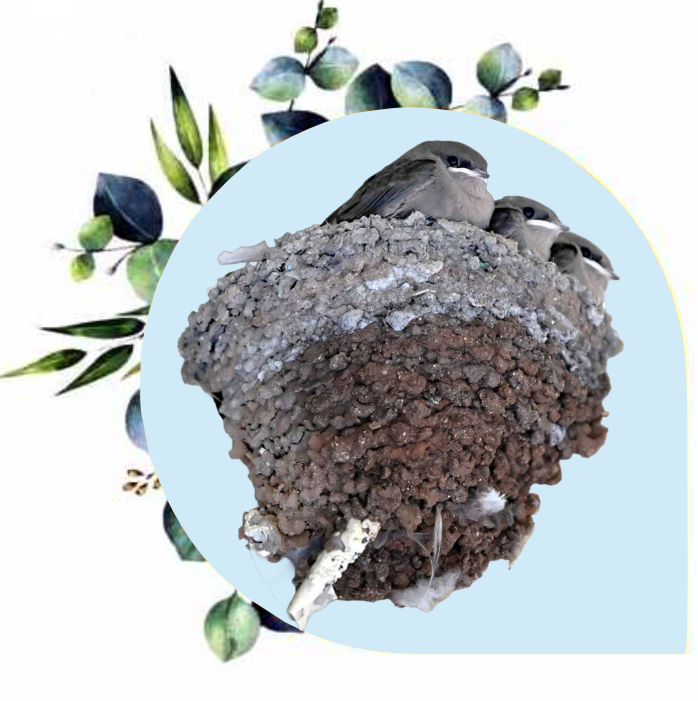
The Little Architects of
The Palace
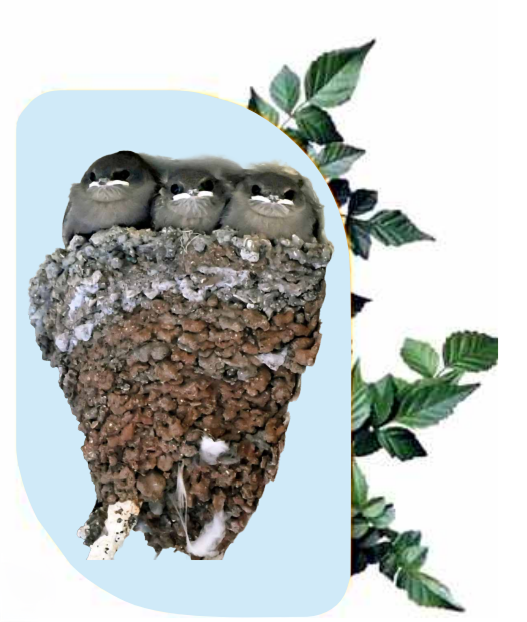
A Story of Swifts, Instinct and Living Heritage
High above our heads, in the quiet corners of old buildings, an extraordinary piece of architecture is taking shape—one tiny feather, blade of grass and strand at a time.
The birds responsible are the Indian House Swifts, or Little Swifts (Apus affinis)—small, smoky-black birds distinguished by their white throat and rump. Found widely across India and much of Africa and Asia, they have a remarkable affinity for human habitation, making their homes beneath eaves, arches, bridges and the sheltered corners of old buildings.
Their nests are perhaps their greatest marvel. Constructed from grass, feathers and other light materials, the fragments are painstakingly bound together with the bird's own saliva. What appears from a distance to be a rough, almost primitive structure is, in fact, a remarkably ingenious home—light, compact and firmly attached to a vertical surface. Colonies may contain numerous nests, sometimes returning to and repairing the same sites year after year.
The swift itself is an extraordinary creature. About 15 centimetres long, it is built for life in the air, with long, narrow wings and a wide gape perfectly suited to catching insects mid-flight. Flies, midges and other airborne insects form much of its diet. It can spend astonishing lengths of time airborne and is poorly adapted to walking on the ground.
Today, the Little Swift remains a widespread resident of India and is globally classified as Least Concern. Yet India's latest bird assessment records a long-term decline of about 30%, even as its recent annual trend shows an increase—an intriguing reminder that abundance should never be mistaken for permanence.
Perhaps that is what makes these tiny residents so special in a heritage property.
Human hands built the palace; instinct built the nest. Both are expressions of craftsmanship, continuity and a remarkable ability to endure.
www.hrhhotels.com
| First | Prev | 04 | Next | Last |